Download a new resource from the Western Educational Equity Assistance Center that offers education leaders an alternative to top-down, compliance-driven approaches to improving attendance: human-centered leadership practices that prioritize empathy, flexibility, and collaboration to understand and address the barriers keeping students out of school.
Chronic Absenteeism
Improving Attendance Through Human-Centered Leadership Practices
Regular school attendance is a strong predictor of academic success, yet many attendance strategies rely on top-down, compliance-driven approaches that fall short of addressing root causes. This brief from WestEd’s Western Educational Equity Assistance Center offers education leaders an alternative: human-centered leadership practices that prioritize empathy, flexibility, and collaboration to understand and address the barriers keeping students out of school. The brief organizes its guidance around three levels of action. At the individual level, leaders examine their own mindsets about absences. At the collective level, staff, students, and families work together to bridge perspectives and learn from shared data. At the systems level, leaders adapt policies and routines to better serve those least well supported by current approaches.
For each level, the brief pairs practices, such as strengthening self-awareness, navigating diverse perspectives, and fostering transparent communication, with reflection questions and practical “Try It Out” activities that leaders can apply directly in their schools. Ultimately, the brief calls on education leaders to cultivate trust and engage those most affected by attendance challenges, positioning human connection as central to creating lasting improvements in attendance.
Connection, Trust, and Learning: Student Attendance in the Middle and High School Grades Following the COVID-19 Pandemic
This brief summarizes findings from the first year of a multi-year study examining the causes, consequences, and impacts of absenteeism in Chicago in post-pandemic years relative to pre-pandemic years among students in grades 6-11. We focus on the middle and high school grades because these are years when many students show a rise in absences, relative to their attendance in the elementary grades.
How Are States Handling Chronic Absenteeism? Evaluating State Capacity to Address Chronic Absenteeism
Supporting Success: Attendance Solutions for Multilingual Students
This brief examines chronic absenteeism among multilingual learners in the U.S., with a particular focus on the post-COVID-19 era. It highlights the varied challenges these students face, which range from language barriers and cultural differences to socioeconomic difficulties. Highlighting the importance of creating welcoming environments and forging strong community ties, the brief advocates for comprehensive support measures to help multilingual learners navigate challenges and achieve academic success.
Pathways to Re-Engagement: Summer Opportunities
In this webinar, participants explored strategies to address the rising chronic absence rates, which reached 29.7% in the 2021-22 school year. Participants also discovered how schools and community organizations enhance family engagement and student connectedness to foster re-engagement, particularly throughout the critical summer months.
African American Student Attendance and Engagement: Challenges and Solutions
This is the second in a four-part blog post series offering strategies for increasing educational equity by reducing chronic absence.
By Maria Casey and Helen Duffy, Attendance Works
Though our nation has made progress in increasing educational opportunities for African American students, educational inequities persist, and disparities in attendance, engagement, and learning are on the rise. These disparities continue despite the tremendous strengths and assets found in the cultures and traditions of African American communities. While they may appear daunting, the problems that African American students face in our schools are not intractable.
A Different Perspective and a Shift in the Narrative
In this blog, we provide examples of two schools that are debunking negative perceptions and stereotypes of African American students to demonstrate what is possible when schools provide quality educational opportunities.
Help Students Reach Their Full Potential
At West Seattle Elementary School in Seattle, WA, where two thirds of enrolled students are African American, school leaders and teachers lead with the assumption that the educator’s role is to help students realize their full potential. Before students enroll, Principal McCowan-Conyers meets with each new family and asks them to share their hopes and dreams for their children and communicates the high expectations she has for every student. She is intentional about hiring staff who reflect the school’s demographics and can understand the lived realities of families.[1]
Many of the students are refugees from East African countries who have experienced trauma. McCowan-Conyers was the first principal in Seattle to replace a counseling position with a licensed social worker who provides families with connections to community partners and acts as a family advocate. Once a week, McCowan-Conyers meets with the school counselor, social worker, nurse, head teacher, and secretary to review data and identify students who might benefit from additional follow up support when needs arise. These individuals work in partnership with families to identify solutions to attendance barriers, such as a walking school bus for students to walk to school safely together, gas cards for families who need that support, and a principal-led school “state of the union” for families in which McCowan-Conyers invites their suggestions for things school administrators, educators, and staff can do better.
Key to success is offering challenging, engaging academic and enrichment programs. Through the STEAM program, students learn coding with the help of industry experts and can join extracurricular activities such as robotics, chess, and an adventure club. A partnership with the local YMCA offers students after-school programs and homework support. These activities open new learning experiences for students.
Work to address chronic absence still needs to be done at West Seattle Elementary, which had an overall chronic absence rate in 2022/23 of 41.2 percent, McCowan-Conyers says. However, the absenteeism rate for African American students was comparatively better, with 34.2 percent of African American students chronically absent.
Build Trusting Relationships Among Students and Between Adults and Students
Building trusting relationships among students and between adults and students is a central component of student success at O’Farrell Charter High School. Studies have found that when students have at least one relationship with a caring adult, students feel more motivated, have a greater sense of self-efficacy, and meet with greater academic success. One study of a City Year program that places teams of AmeriCorp members in under-resourced schools found improvements in student social–emotional skills and academic outcomes in those schools. The study found that increases in social-emotional skills contribute to improved attendance.
By partnering with community-based or national organizations such as City Year, schools can help students build adult–student relationships. Schools can also offer time during the school day for students and staff to build those relationships. In elementary schools, this might mean creating routines and rituals during morning meetings to check in with students and acknowledge students who are absent. In secondary school, it might mean incorporating a regular class period into the school day when students and adults can build trust and community.
One case study of a school in San Diego provides a promising example.[2] In 2022/23, students at O’Farrell Charter High School in San Diego had an overall chronic absence rate of 9.6 percent, with 12 percent of African American students chronically absent, which is 3 times less than the state average. In this school, all incoming 9th grade students are assigned a home base teacher who stays with them throughout their 4 years of high school. Home base teachers meet with students every day for 25 minutes, engaging in activities designed to help them learn about each other, strengthen positive social–emotional skills, and build a sense of community.
Home base teachers are also responsible for building positive relationships with families. Building these relationships takes time, commitment, and persistence, particularly with those who have been historically underserved by schools. Home base teachers monitor grades and attendance and can intervene well before the end of a marking period. If students are sent out of another class for disciplinary reasons, the home base teacher works with the student and teacher to resolve the situation. Though these are not typical responsibilities of traditional high school teachers, seeing the impact of their efforts is convincing evidence for teachers who are reluctant to take on this role.
Take a Systems Approach
District offices have an important role to play in supporting schools to interrupt chronic absence, and it is essential that superintendents and school boards are aligned in their commitment to practices that support African American students and families. When district and school leaders are committed to examining data that reveal persistent failures to provide opportunities for African American students to flourish, those leaders must confront questions that may be uncomfortable. For example, Madera Unified School District in California’s Central Valley conducted a student survey that revealed differences in students’ experiences in school, with African American students consistently reporting a higher number of negative experiences than their peers. Student focus groups revealed a similar pattern. After confronting those patterns, district and school staff joined students and families to create a Student Champion workgroup. That workgroup developed a Student Bill of Rights, which was later approved by the school board.
The Student Bill of Rights spells out the kinds of experiences all students should have in district schools and mandates that anti-bias training be provided to every staff person in the district. Doing this work took courage and persistence. Although Madera’s chronic absence rate in 2022/23 was 27.3 percent, the Student Bill of Rights is a positive step toward mutual accountability that may help improve student attendance and engagement.
Focus on Positive Conditions for Learning
These stories demonstrate that when schools and districts intentionally focus on positive conditions for learning, African American students can flourish.
© Attendance Works, attendanceworks.org
It is also critical that school leaders address barriers to attendance and engage students and families as partners in shaping expectations for school experiences. This begins with building trusting relationships with students and families and eliciting from them what they need to engage and succeed in school. Examining data and having the courage to act when those data reveal inequities are important first steps in addressing challenges.
Implementing a Tiered System of Supports can help schools identify the right strategies. This begins with communicating the importance of regular attendance, offering a wide range of after-school activities, or providing all students with a “home base,” as O’Farrell Charter High School does.
It is also important to implement culturally appropriate universal Tier 1 supports, like offering warm and welcoming greetings when students enter school and displaying artifacts in hallways and classrooms that celebrate the diversity of ethnic and cultural groups in the school. When chronic absence rates are similar for all student groups, it is a sign that Tier 1 supports should be expanded or deepened. When chronic absence is high among African American students, it may indicate that those Tier 1 supports are not designed to meet their needs.
For students and families experiencing greater challenges, schools might implement Tier 2 strategies such as a walking school bus or gas cards. When Tiers 1 and 2 supports prove inadequate, schools may benefit from partnering with community-based organizations to provide additional support on a case-by-case basis.
Problems that seem intractable are problems we can solve. We must be intentional, courageous, and confident that our schools can serve and support our African American students in more ways that are holistic and responsive.
[1] Blazar, D. (2024). Why Black teachers matter (EdWorkingPaper: 21-501). Annenberg Institute at Brown University. https://doi.org/10.26300/jym0-wz02
[2] Johnson, J., Jr., Uline, C.L., & Munro, S. J., Jr. (2023). When Black students excel: How schools can engage and empower Black students. Routledge.
Missing More Than School: Reducing Chronic Absence for American Indian and Alaska Native Students
Nearly half (47%) of American Indian/Alaska Native (AI/AN) students in the United States were chronically absent in school year (SY) 2021/22.1 This represents a 16.8 percent increase from the 30 percent chronic absence rates of AI/AN students prior to the pandemic. This knowledge brief describes ways to partner with AI/AN students, families, and communities to understand and address the challenges they face in attending and thriving in school.
From Absences to Action: Strategies to Reduce Chronic Absence and Increase Educational Equity
This is the first in a four-part blog post series offering strategies for increasing educational equity by reducing chronic absence.
By Hedy N. Chang, Executive Director and Founder, Attendance Works
Addressing today’s unprecedented levels of chronic absence in schools across the country is essential for ensuring all students have an equal opportunity to learn and thrive.
Chronic absence is defined as missing 10 percent or more of school for any reason. Left unaddressed, chronic absence can result in students struggling to read by grade 3, low academic achievement in middle school, and not graduating from high school.
National data show that nearly 14.7 million students (29.7%) were chronically absent in the 2021–22 school year, with roughly 6.5 million more students missing 10 percent or more of school days, when compared with the school year before the pandemic. Although available state data from SY 2022–23 show that chronic absence is starting to decline from its pandemic-impacted peak, it remains at staggeringly high levels.
Who is affected by chronic absence?
Chronic absence now affects the educational experience of most students in the United States—regardless of their ethnicity. When absenteeism reaches significantly high levels in a school, the educational experience of all students, not just those frequently missing school, is also affected. The churn in the classroom and the school affects teachers’ abilities to teach and establish classroom norms and makes it more difficult for students to learn. Research shows that elevated levels of chronic absence decrease achievement for all students.
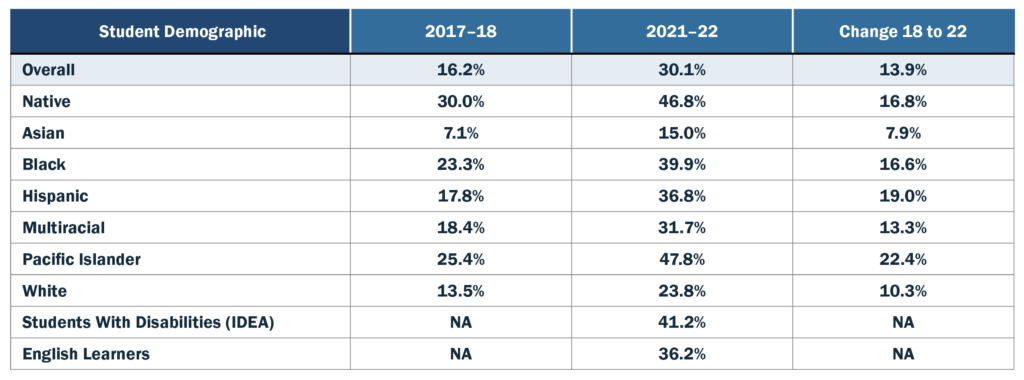
Before the pandemic, only a quarter (25%) of all enrolled students attended schools in which at least 20 percent of students were chronically absent. In SY 2021–22, two-thirds (66%) of enrolled students attended a school with such high chronic absence. In SY 2021–22, the largest number of chronically absent students were white (5.2 million), followed by Latino (5 million) and African American (2.9 million). National data shows that chronic absence is equally divided among male and female students. At the same time, much higher percentages of Native American, Hispanic, Pacific Islander, and Black students, as well as students with disabilities and English Learners, are chronically absent.
Table 1. Percentage of Population Who Are Chronically Absent
Note: https://weeac.wested.org/wp-content/uploads/2024/03/WEEAC-Blog-From-Absences-to-Action-Appendix-03.11.ADA_FINAL.pdf
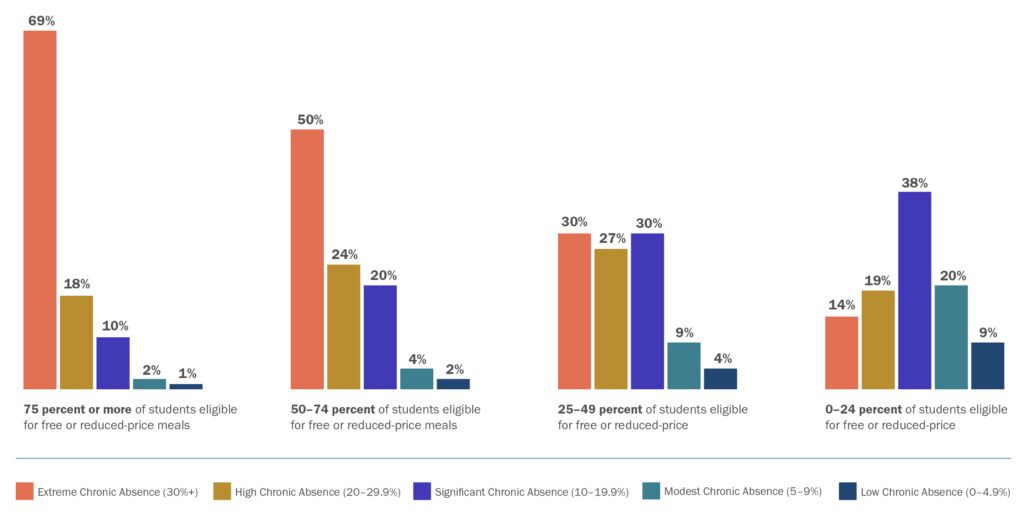
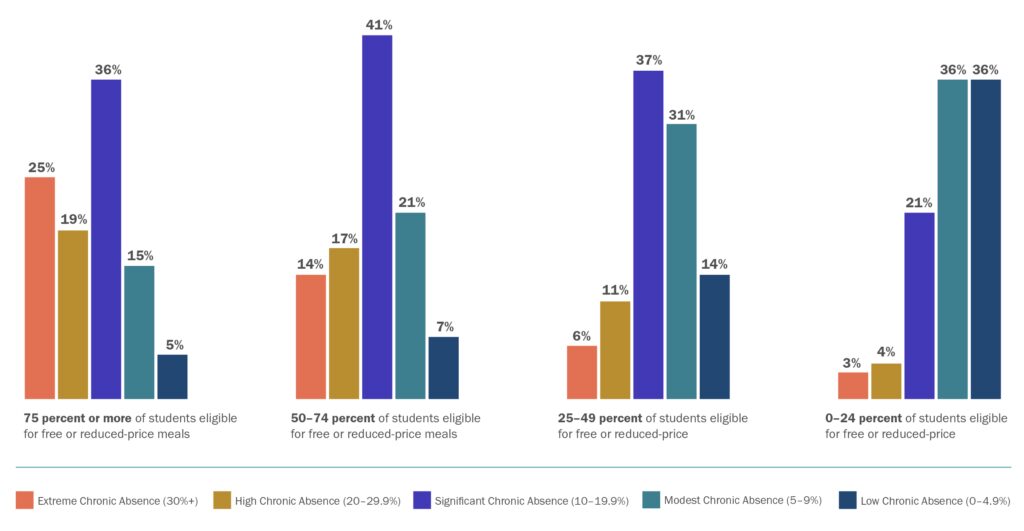
According to a 2021 Report by Attendance Works and the Everyone Graduates Center, students from populations with historically less access to educational opportunity are also much more likely to be enrolled in schools with extreme levels (greater than 30%) of chronic absence. Among schools with 75% or more of their students receiving free or reduced-price lunch (FRPL), schools with extreme chronic absence levels nearly tripled, from 25 percent in SY 2017–18 to 69 percent in SY 2021–22. Among schools with 50 percent to 75 percent FRPL, it increased from 14 percent to 50 percent. (See Charts 1 and 2.) Similar patterns hold for schools serving 75 percent or more students of color.
Figure 1. School Chronic Absence Levels by Concentration of Poverty, SY 2021–22
Defined as percent of students eligible for free- or reduced-price meals*
Note: https://weeac.wested.org/wp-content/uploads/2024/03/WEEAC-Blog-From-Absences-to-Action-Appendix-03.11.ADA_FINAL.pdf#page=2
Figure 2. School Chronic Absence Levels by Concentration of Poverty, SY 2017–18
Defined as percent of students eligible for free- or reduced-price meals*
Note: https://weeac.wested.org/wp-content/uploads/2024/03/WEEAC-Blog-From-Absences-to-Action-Appendix-03.11.ADA_FINAL.pdf#page=4
In addition, the most economically challenged districts are much more likely to have multiple schools with extreme levels of chronic absence than more affluent districts. For more information, see All Hands on Deck.
How do we address these unprecedented levels of chronic absence?
Districts, schools, and community agencies can embed the following strategies in their existing initiatives and operations to increase student attendance and engagement.
- Ensure actionable data. Because attendance data is collected daily, it is an invaluable tool for offering immediate and ongoing feedback. Chronic absence data, when disaggregated by grade, school, student group, and if possible, neighborhood, can be used to identify which students, student groups, and communities need more targeted resources and support and early intervention before situations are harder to resolve. But this can only occur when chronic absence data is accessible to the public, accurate, easy to understand, and timely.
- Change the blame mindset. Too often when absences start to add up, the initial reaction is to blame the child or their family for not caring enough to make school a priority. But, as this report by AIR and Attendance Works discusses, absences are caused by systemic challenges in the community that are beyond a student’s or family’s control (e.g., lack of access to health care, unreliable transportation, unstable housing, lack of safe paths to school) as well as in school (e.g., an unwelcoming school climate, biased disciplinary or attendance practices, or lack of a meaningful and culturally relevant curriculum). A blaming response can worsen the situation by causing the student and family to feel alienated, distrustful, and angry. This is especially the case if a student and family have experienced trauma, which this 2017 study appearing Academic Pediatrics shows is highly correlated to chronic absence.
Attendance can be improved by changing how we communicate with families about unexcused absences. This 2019 paper, Using Behavioral Insights to Improve Truancy Notifications, conducted in California, found that truancy notifications were much more effective when the notices did not begin with the state-mandated legalistic language or did not threaten punitive action. The more effective letters listed the specific days a student missed, offered clear information about the potential consequences of chronic absence on learning, the important role parents play in getting their children to school, and encouragement and support for parents and guardians to help their children get to school.
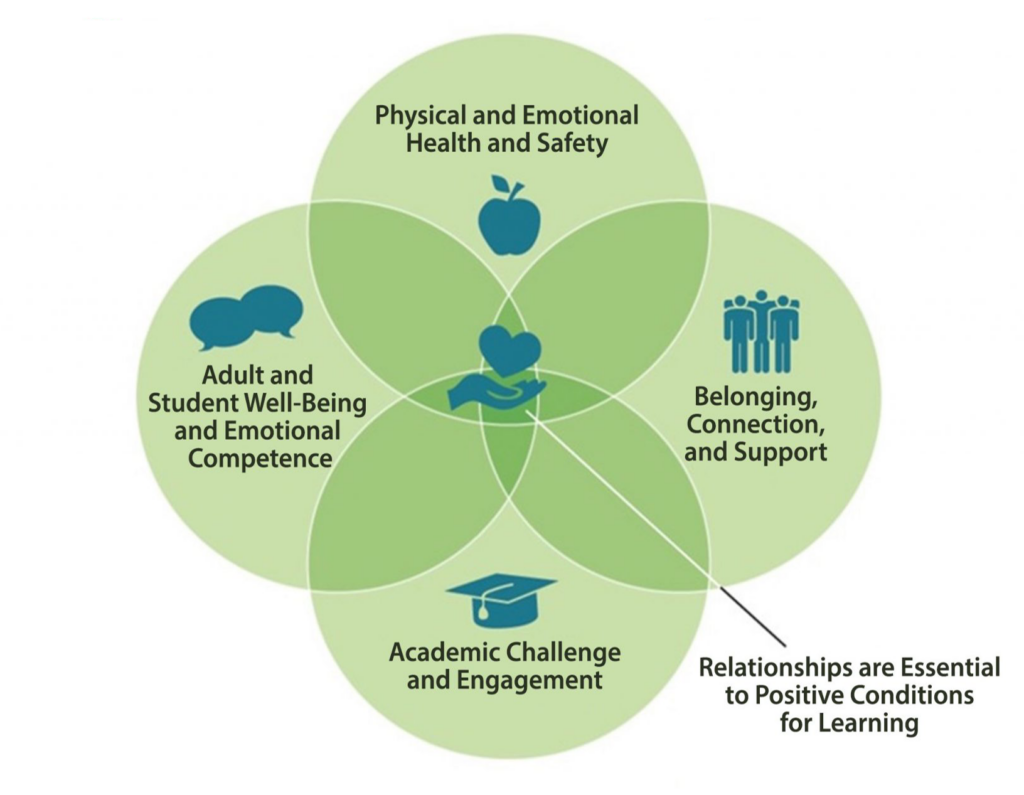
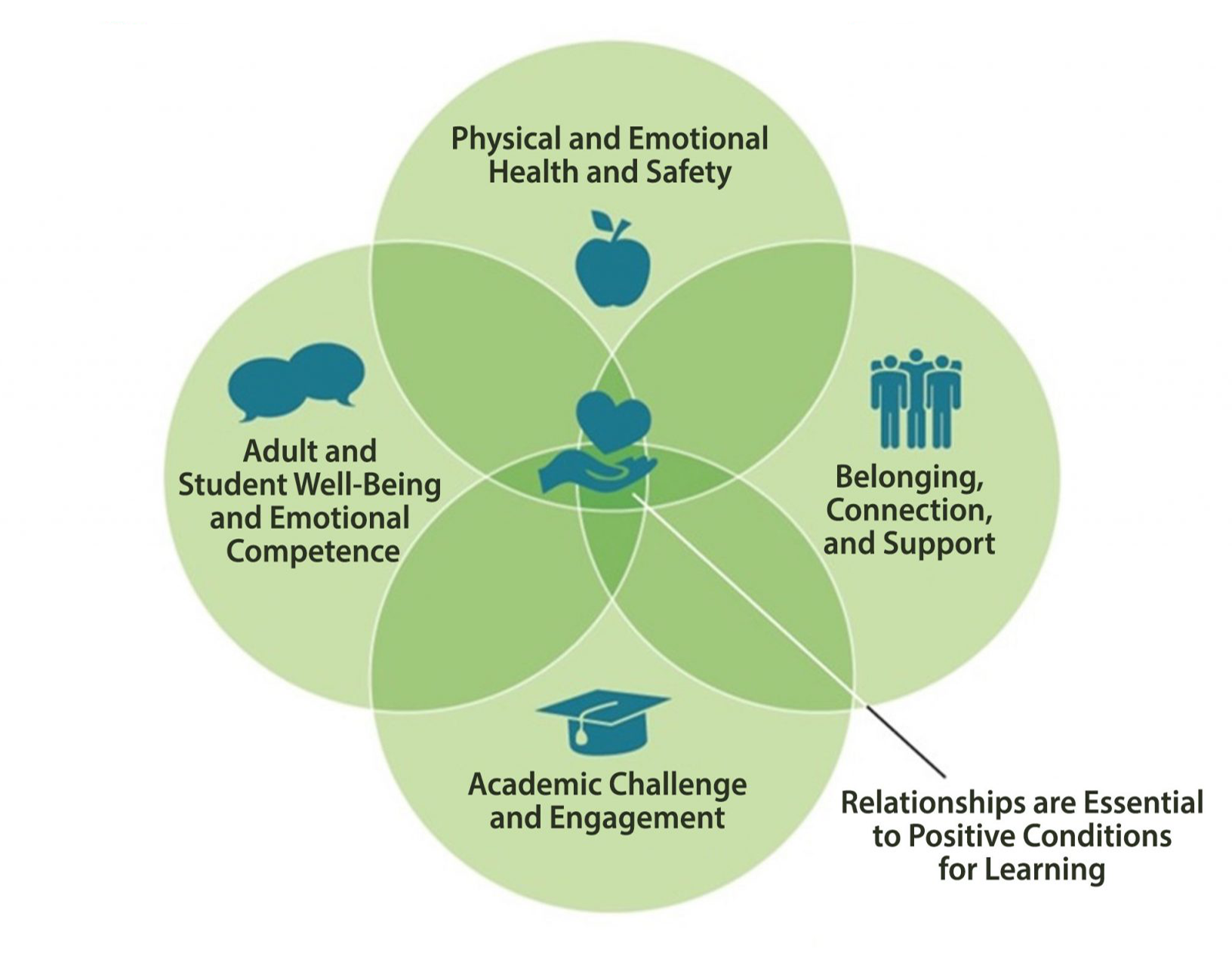
An essential element of changing mindsets is ensuring schools, districts, and communities invest in a multi-tiered approach that emphasizes prevention and early intervention where referral to the court system is used as a last resort. - Invest in relationship building and positive conditions for learning. As this article published in 2023 by the National School Boards of Education discusses, high levels of chronic absence in a school or district are a red flag that the positive conditions that motivate showing up to school have been eroded. These positive conditions for learning include healthy and safe school environments, a sense of belonging, connection, and support; academic challenge and engagement; and adult and student well-being and emotional competence.
Positive Conditions for Learning Lead to Students Being Engaged and Attending Regularly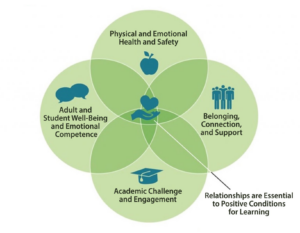
© Attendance Works, attendanceworks.org
Relationship building is the most critical ingredient. An October 2023 analysis by Learning Heroes and TNTP found that schools with higher levels of family engagement had significantly lower increases in chronic absence during the pandemic. The positive impact of family engagement was greater for families with incomes below the poverty line. Attendance also reflects student connectedness. Students are connected to schools when they believe there is an adult at school who knows and cares about them, they have a supportive peer group, they engage at least some of the time in activities they find meaningful and that help others, and they feel seen and welcome in school. For example, having a teacher of the same racial background is associated with fewer unexcused absences. To be effective, engagement strategies must be culturally and linguistically appropriate for students and families. Attendance improves when districts ensure real-time communication in the family home language. - Partner with students and families to understand the challenges that cause absences and what helps them reengage and show up regularly. Improving student attendance requires understanding and addressing the root causes that lead to students’ missing school in the first place. Although some factors, such as school climate or attendance and discipline policies, are more within the locus of control of schools, others—for example, housing instability or community violence—are not easily addressed by school districts alone. When chronic absence affects larger numbers of students, it indicates challenges that require more systemic and programmatic solutions and the support of community partners.
Putting in place meaningful solutions requires deepening our understanding of what affects attendance for the student groups who make up the largest numbers of chronically absent students as well as those groups who are disproportionately affected by chronic absence. A variety of qualitative data collection methods (empathy interviews, surveys, focus groups) should be employed to gather insights directly from students and families. Tapping into student and family voices helps ensure that the engagement strategies are inclusive of students’ and families’ cultural norms. - Collaborate with community organizations and tribal governments. Helping students and families overcome attendance barriers requires strong and strategic collaboration with the agencies and organizations in your community who already know the languages and cultures of students and families. Such organizations might be able to offer resources (health care, mental health supports, housing, food, transportation, etc.) that can help families overcome obstacles that prevent their children from getting to school. For American Indian and Alaska Native students, reaching out to tribal governments is especially essential. Once you’ve identified the organizations, learn about each other and identify areas of common interest. Share data, as appropriate, on which students are chronically absent so that you can coordinate the needed outreach.
- Utilize teams at the district and school levels. Tackling chronic absence, especially when it affects significant numbers of students, is not a solo endeavor. It requires the support of district and school teams who have the insights, resources, and data needed to design, implement, and assess the effectiveness of activities and interventions. Such teams should not only focus on the case management of particular students but establish a strategic and systemic approach to improving attendance. Effective teams include members who reflect the demographics of the students and families served.
The continued high levels of chronic absence in schools across the country are an urgent call to action for all of us to work together to reengage our students and families and address the root causes of educational inequity occurring inside and outside of schools.
This product is prepared for the Western Educational Equity Assistance Center (WEEAC) at WestEd, which is authorized under Title IV of the Civil Rights Act of 1964 and funded by the U.S. Department of Education. Equity Assistance Centers provide technical assistance and training to school districts and tribal and state education agencies to promote equitable education resources and opportunities regardless of race, sex, national origin, or religion. The WEEAC at WestEd partners with Pacific Resources for Education and Learning and Attendance Works to assist Alaska, American Samoa, Arizona, California, Colorado, the Commonwealth of the Northern Mariana Islands, Guam, Hawaiʻi, Idaho, Montana, Nevada, New Mexico, Oregon, Utah, Washington, and Wyoming.
The contents of this product were developed under a grant from the Department of Education. However, the contents do not necessarily represent the policy of the Department of Education, and you should not assume endorsement by the federal government.
Chronic Absence Session #6 – Increasing Attendance and Engagement for Multilingual Learners
Amid the pandemic, chronic absenteeism surged dramatically for multilingual learners. In California, chronic absence among English Learners nearly tripled from 2018 to 2022. Nationally, 36.2% of all English Learners were reported chronically absent during the 2021-22 school year. Our session focused on the challenges and opportunities for multilingual students, exploring culturally responsive strategies to boost attendance and engagement. Participants discovered actions taken by districts and schools to improve attendance.