This tip sheet for educators offers several high-level principles that educators can consider, followed by nine self-reflection questions. These allow individuals or teams to evaluate their practices along a continuum: A high rating may indicate that social and emotional well-being practices are already anchored in equity, whereas a low score may indicate that well-intended practices are actually working at cross-purposes with equity.
Student Well-Being
The Toolkit Before the Toolkit: Centering Adaptive and Relational Elements of Restorative Practices for Implementation Success
Restorative practices are characterized by proactive relationships, connection, and community transformation. When implemented correctly, restorative practices are not more to do, but a different way to be.
This guide highlights the mindsets, values, social capital, and structural supports that bind and hold together restorative practices.
Educators, school leaders, and district administrators can use this practical guide to successfully implement restorative practices and transform their schools into strong communities with meaningful relationships, a sense of authentic belonging, and equitable whole-person outcomes.
Reimagining School Safety: A Guide for Schools and Communities
While school safety ideas and practices have evolved over the last several decades, the variety of school safety tools, policies, and degrees of success highlights a need for more conversation about the very concept of safety: what it is (and isn’t), who gets to define it, how it’s achieved, and at what cost.
In shifting how safety is defined so that it is not the absence of violence but the existence of systems and structures that support mutual care, belonging, and interconnection, schools’ policies, practices, and values shift towards creating strong communities and places of collaborative learning.
The purpose of this guide is to support education professionals reimagine and redefine school safety such that safety is not the absence of a negative but rather the existence of positive elements like interconnection, belonging, voice, and agency. Further, working from this paradigm of safety and centering the lived experiences of students and families—especially those who have been kept furthest from institutional power—can be a key component of designing systems that are more equitable and sustainable.
This interactive guide pulls from different frameworks and concepts, including complex adaptive systems, restorative justice, co-designing, and design thinking, to provide educators, school leaders, and district administrators with mindsets, strategies, and grounded examples of what is possible by reimagining school safety.
Stories of Learning and Well-Being
Across the country, teachers and leaders value well-being, connection, and equity and see it as foundational to their school communities—however, many struggle with how to provide these for students, staff, and families.
The Stories of Learning and Well-Being audiocast series is designed to help educators equitably serve the whole-person needs of their communities.
Listen to stories from a public school or district across the United States, describing their innovative, evidence-based approach to this work.
A short brief, school or district demographic information, and a list of resources accompany each audiocast.
Each audiocast is accompanied by a companion brief and an implementation guide to help you adapt these practices for your school.
Creating and Sustaining Discipline Policies That Support Students’ Social, Emotional, Behavioral, and Academic Well-Being and Success: Strategies for School and District Leaders
This fact sheet is one of four developed by a collaboration between the U.S. Department of Education, the Office of Elementary and Secondary Education, and the Office of Safe and Supportive Schools technical assistance centers to enhance state and district implementation learning environments that are safe, inclusive, supportive, and fair.
African American Student Attendance and Engagement: Challenges and Solutions
This is the second in a four-part blog post series offering strategies for increasing educational equity by reducing chronic absence.
By Maria Casey and Helen Duffy, Attendance Works
Though our nation has made progress in increasing educational opportunities for African American students, educational inequities persist, and disparities in attendance, engagement, and learning are on the rise. These disparities continue despite the tremendous strengths and assets found in the cultures and traditions of African American communities. While they may appear daunting, the problems that African American students face in our schools are not intractable.
A Different Perspective and a Shift in the Narrative
In this blog, we provide examples of two schools that are debunking negative perceptions and stereotypes of African American students to demonstrate what is possible when schools provide quality educational opportunities.
Help Students Reach Their Full Potential
At West Seattle Elementary School in Seattle, WA, where two thirds of enrolled students are African American, school leaders and teachers lead with the assumption that the educator’s role is to help students realize their full potential. Before students enroll, Principal McCowan-Conyers meets with each new family and asks them to share their hopes and dreams for their children and communicates the high expectations she has for every student. She is intentional about hiring staff who reflect the school’s demographics and can understand the lived realities of families.[1]
Many of the students are refugees from East African countries who have experienced trauma. McCowan-Conyers was the first principal in Seattle to replace a counseling position with a licensed social worker who provides families with connections to community partners and acts as a family advocate. Once a week, McCowan-Conyers meets with the school counselor, social worker, nurse, head teacher, and secretary to review data and identify students who might benefit from additional follow up support when needs arise. These individuals work in partnership with families to identify solutions to attendance barriers, such as a walking school bus for students to walk to school safely together, gas cards for families who need that support, and a principal-led school “state of the union” for families in which McCowan-Conyers invites their suggestions for things school administrators, educators, and staff can do better.
Key to success is offering challenging, engaging academic and enrichment programs. Through the STEAM program, students learn coding with the help of industry experts and can join extracurricular activities such as robotics, chess, and an adventure club. A partnership with the local YMCA offers students after-school programs and homework support. These activities open new learning experiences for students.
Work to address chronic absence still needs to be done at West Seattle Elementary, which had an overall chronic absence rate in 2022/23 of 41.2 percent, McCowan-Conyers says. However, the absenteeism rate for African American students was comparatively better, with 34.2 percent of African American students chronically absent.
Build Trusting Relationships Among Students and Between Adults and Students
Building trusting relationships among students and between adults and students is a central component of student success at O’Farrell Charter High School. Studies have found that when students have at least one relationship with a caring adult, students feel more motivated, have a greater sense of self-efficacy, and meet with greater academic success. One study of a City Year program that places teams of AmeriCorp members in under-resourced schools found improvements in student social–emotional skills and academic outcomes in those schools. The study found that increases in social-emotional skills contribute to improved attendance.
By partnering with community-based or national organizations such as City Year, schools can help students build adult–student relationships. Schools can also offer time during the school day for students and staff to build those relationships. In elementary schools, this might mean creating routines and rituals during morning meetings to check in with students and acknowledge students who are absent. In secondary school, it might mean incorporating a regular class period into the school day when students and adults can build trust and community.
One case study of a school in San Diego provides a promising example.[2] In 2022/23, students at O’Farrell Charter High School in San Diego had an overall chronic absence rate of 9.6 percent, with 12 percent of African American students chronically absent, which is 3 times less than the state average. In this school, all incoming 9th grade students are assigned a home base teacher who stays with them throughout their 4 years of high school. Home base teachers meet with students every day for 25 minutes, engaging in activities designed to help them learn about each other, strengthen positive social–emotional skills, and build a sense of community.
Home base teachers are also responsible for building positive relationships with families. Building these relationships takes time, commitment, and persistence, particularly with those who have been historically underserved by schools. Home base teachers monitor grades and attendance and can intervene well before the end of a marking period. If students are sent out of another class for disciplinary reasons, the home base teacher works with the student and teacher to resolve the situation. Though these are not typical responsibilities of traditional high school teachers, seeing the impact of their efforts is convincing evidence for teachers who are reluctant to take on this role.
Take a Systems Approach
District offices have an important role to play in supporting schools to interrupt chronic absence, and it is essential that superintendents and school boards are aligned in their commitment to practices that support African American students and families. When district and school leaders are committed to examining data that reveal persistent failures to provide opportunities for African American students to flourish, those leaders must confront questions that may be uncomfortable. For example, Madera Unified School District in California’s Central Valley conducted a student survey that revealed differences in students’ experiences in school, with African American students consistently reporting a higher number of negative experiences than their peers. Student focus groups revealed a similar pattern. After confronting those patterns, district and school staff joined students and families to create a Student Champion workgroup. That workgroup developed a Student Bill of Rights, which was later approved by the school board.
The Student Bill of Rights spells out the kinds of experiences all students should have in district schools and mandates that anti-bias training be provided to every staff person in the district. Doing this work took courage and persistence. Although Madera’s chronic absence rate in 2022/23 was 27.3 percent, the Student Bill of Rights is a positive step toward mutual accountability that may help improve student attendance and engagement.
Focus on Positive Conditions for Learning
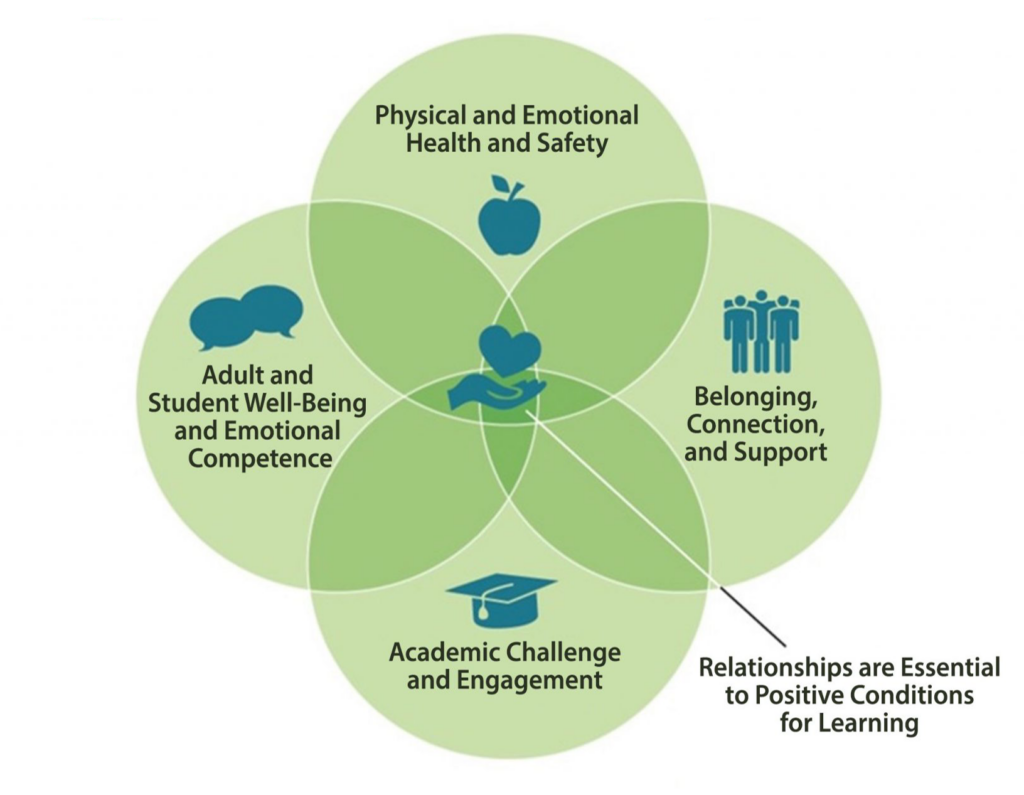
These stories demonstrate that when schools and districts intentionally focus on positive conditions for learning, African American students can flourish.
© Attendance Works, attendanceworks.org
It is also critical that school leaders address barriers to attendance and engage students and families as partners in shaping expectations for school experiences. This begins with building trusting relationships with students and families and eliciting from them what they need to engage and succeed in school. Examining data and having the courage to act when those data reveal inequities are important first steps in addressing challenges.
Implementing a Tiered System of Supports can help schools identify the right strategies. This begins with communicating the importance of regular attendance, offering a wide range of after-school activities, or providing all students with a “home base,” as O’Farrell Charter High School does.
It is also important to implement culturally appropriate universal Tier 1 supports, like offering warm and welcoming greetings when students enter school and displaying artifacts in hallways and classrooms that celebrate the diversity of ethnic and cultural groups in the school. When chronic absence rates are similar for all student groups, it is a sign that Tier 1 supports should be expanded or deepened. When chronic absence is high among African American students, it may indicate that those Tier 1 supports are not designed to meet their needs.
For students and families experiencing greater challenges, schools might implement Tier 2 strategies such as a walking school bus or gas cards. When Tiers 1 and 2 supports prove inadequate, schools may benefit from partnering with community-based organizations to provide additional support on a case-by-case basis.
Problems that seem intractable are problems we can solve. We must be intentional, courageous, and confident that our schools can serve and support our African American students in more ways that are holistic and responsive.
[1] Blazar, D. (2024). Why Black teachers matter (EdWorkingPaper: 21-501). Annenberg Institute at Brown University. https://doi.org/10.26300/jym0-wz02
[2] Johnson, J., Jr., Uline, C.L., & Munro, S. J., Jr. (2023). When Black students excel: How schools can engage and empower Black students. Routledge.
Newcomer Toolkit
The Newcomer Toolkit is designed to help U.S. educators, elementary and secondary teachers, principals, and other school staff who work directly with immigrant students—including asylees and refugees—and their families.
The Newcomer Toolkit has 5 chapters, and contains an overview, sample tools, and resources
In this guide:
Chapter 1 – Who Are Newcomers?
Chapter 2 – Welcoming Newcomers to a Safe, Inclusive and Thriving School Environment
Chapter 3 – Supporting Newcomers’ Social, Emotional, and Mental Health Needs
Chapter 4 – Providing High-Quality Instruction for Newcomers
Chapter 5 – Establishing Partnerships with Families
From Policy to Practice: Preventing and Addressing Bullying and Discriminatory Harassment
This webinar delves into the implementation of policies within educational environments. It provides valuable resources and practical insights from district leaders who have successfully defeated bullying along with shared evidence-based strategies to disrupt such behaviors.
Transformative Social-Emotional Learning in Action: An Approach for Creating a More Equitable Learning Environment
Imagine a community where young people are flourishing academically and socially, where students feel a strong sense of belonging because their unique qualities, perspectives, and identities are valued and respected. Here, students are not only equipped with the necessary academic skills but also possess the emotional tools to navigate the complexities of life.
Within this idyllic school community, engagement is at an all-time high. Students are actively involved in their learning, eagerly participating in classroom discussions, collaborating with peers, and taking ownership of their educational journey. They are not limited by societal expectations or stereotypes; rather, they are encouraged to become agents of change within the school and broader society.
This vision is worth striving for, and Transformative Social-Emotional Learning (tSEL) provides a framework that brings us one step closer to this imagined ideal.
Why do today’s students need SEL?
As the global pandemic recedes, education leaders, classroom teachers, and parents have been left to grapple with the numerous academic and social-emotional challenges facing young people and their wellbeing today. Isolation from peers, overwhelming uncertainty, and deepening societal rifts and inequities impacted students’ educational journeys. Many students have grappled with academic setbacks while simultaneously confronting significant social-emotional hurdles, such as heightened anxiety, loneliness, and a weakened sense of belonging. As education leaders, teachers, and parents strive to address these challenges, SEL can help to build resilience, cultivate empathy, and empower students to navigate the post-pandemic world with confidence and compassion.
Social-emotional learning has emerged as a crucial aspect of a whole-child approach to education that extends beyond traditional academic instruction to recognize the importance of relationships and emotional well-being in a student’s development.[1] Research demonstrates that SEL is not only essential for fostering educational equity and excellence but also for accelerating learning.[2] Moreover, SEL plays a vital role in addressing chronic absenteeism by helping to create a supportive and inclusive school environment that encourages students to attend school and participate actively in their learning.[3] In the context of pandemic-related challenges, the work of experts like Robert J. Jagers and Deborah Rivas-Drake further emphasizes the significance of SEL in supporting students’ mental health by equipping them with social-emotional skills that promote resilience and foster a sense of well-being[4].
What is Transformative SEL, and how does it differ from other approaches?
Transformative SEL (tSEL[5]) is an equity-centered approach that extends beyond traditional SEL approaches, such as personally responsible and participatory SEL. While personally responsible SEL focuses on risk prevention through improving student behaviors often framed as deficient, and participatory SEL emphasizes individual skills necessary for student success within school, tSEL is a more comprehensive approach that seeks to deepen partnerships between families, schools, and communities to address structural barriers and promote collective well-being.
Specifically, tSEL addresses long-standing gaps in educational opportunities and outcomes by encouraging a thoughtful exploration of individual and environmental factors that contribute to inequities. Through collaborative solutions, tSEL strives to enhance personal, community, and societal well-being and works to mitigate disparities influenced by socioeconomic status, race, home language, disability status, or other social identities.
What does Transformative SEL look like in schools?
The Collaborative for Academic, Social, and Emotional Learning (CASEL) outlines five core competencies of SEL: self-awareness, self-management, social awareness, relationship skills, and responsible decision-making. Transformative SEL extends the CASEL competencies into synergistic expressions of identity, agency, belonging, and engagement.[6] Here is what each of those look like in schools.
Identity as a focus in transformative tSEL, incorporates students’ lived experiences into instruction to ensure students’ social identities, communities, values, and concerns are represented and that students are able to learn from, about, and with others who may not share their backgrounds.
Middle school teachers working with predominantly Latinx youth in a large urban district integrated their students’ lived experiences into their instruction by supplementing the English Language Arts (ELA) curriculum with a collection of short stories about the lives of Latinx youth growing up in the U.S. Infusing discussions on identity, which falls under the umbrella of CASEL’s self-awareness competency, into academic subjects, helped students not only deepen their connection with the curriculum but actively fostered their self-awareness throughout the learning process.[7]
Agency, within the context of tSEL, refers to the empowerment and capacity of students to exercise control and influence over their lives. This encompasses self-regulation, self-efficacy, and collective efficacy (the shared belief in a group’s ability to achieve common goals).
In practice, educators can embed agency by validating student experiences of oppression, creating an environment where students can openly acknowledge social injustice, and helping students develop the skills and knowledge to address these injustices. Additionally, recognizing youth as emerging social change agents fosters their collective efficacy, enabling them to see themselves as capable of making a positive impact on their communities and society as a whole.
Belonging is the multifaceted experience of feeling accepted, respected, and fully included within a particular group or community. Research underscores that a sense of belonging is a fundamental factor in shaping students’ school engagement. When students feel valued, respected, and included within their educational community, they are more likely to be motivated and actively involved in their learning journey.[8]
Operationalizing belonging in school settings requires educators to focus on more than just statistical measures. District leaders in Manatee County in Florida found that students prioritized their nonacademic experiences related to belonging as drivers of their overall engagement.[9] Cultivating belonging in schools can be achieved first by actively listening to young people to understand their school experiences.
Engagement, closely related to students’ sense of belonging and fundamental to their ability to participate in collaborative problem-solving and responsible decision-making, is yet another component of tSEL.
When students are heard, they develop confidence in their expertise and strengthen their sense of agency, making them more invested learners. In a partnership with WestEd, Washoe County School District (WCSD) in Nevada aimed to decrease dropout rates by engaging meaningfully with students at risk of dropping out. Upon doing so, they discovered that when students were provided with a platform to express themselves, not only did they contribute to finding solutions, but they experienced a shift in mindset that resulted in their being more engaged in school.[10]
How can we build parental and community support for Transformative SEL?
As educators increasingly support SEL as a vital component of a whole-child approach to education, SEL terminology can sometimes be perplexing and cause skepticism among parents who desire more emphasis on core academics and those who harbor concerns about potential ideological influences. To gain deeper insight into parental perspectives on SEL and to identify potential challenges in effectively communicating its role within education, the Fordham Institute initiated a nationwide survey of 2,000 parents with children in grades K–12.[11] Based on the findings, here are suggestions for educators and policymakers for adopting tSEL in partnership with communities.
- Engage families and the community to promote collective well-being. A cornerstone of tSEL is relational trust between and among students, educators, parents, and community members. In this vein, it’s crucial to remember that schools aren’t the sole, and often not even the primary, arena for nurturing SEL-related skills. Regardless of political leanings, racial backgrounds, socioeconomic status, or other demographic factors, parents consistently emphasize that families play a critical role in fostering young people’s SEL.
- Emphasize actual skills and competencies over abstract ideas or jargon. When we delve into the particulars and the real-world applications of SEL, parents readily understand and support it. However, when the discussion becomes abstract and lacks concrete examples, many parents find it less engaging and relatable. It’s essential to ground SEL concepts in practical contexts to convey their significance effectively.
- Incorporate SEL skills into core academic subjects. Parents expressed a preference for traditional academic subjects, with disciplines such as math, English/reading, science, computer science, and history, along with career and technical education (CTE), ranking among their top priorities. Additionally, four SEL-related skills also hold high value for parents: taking responsibility for one’s actions, communication/interpersonal skills, self-confidence, and self-motivation. Therefore, a balanced approach that integrates SEL into academic content is encouraged.
In order to effectively adopt Transformative SEL (tSEL) in collaboration with communities, educators and policymakers can focus on building trust among students, parents, educators, and community members, emphasize practical applications of SEL, and integrate SEL into core academic subjects. Below are resources for practitioners to take SEL from theory to practice.
Resources for Practitioners
Connecting Theory to SEL Practice: Five Key Insights from Innovative, Community-Driven SEL Initiatives and Programs
https://oese.ed.gov/files/2023/02/EIR_Connecting-Theory-to-SEL-Practice.pdf
Fundamentals of SEL: What does the research say?
https://casel.org/fundamentals-of-sel/what-does-the-research-say/
Integrating Social and Emotional Learning Throughout the School System: A Compendium of Resources for District Leaders
https://selcenter.wested.org/resources/
Measures of SEL and School Climate in California
https://nasbe.nyc3.digitaloceanspaces.com/2020/05/Allbright-Hough_May-2020-Standard.pdf
Speak Out, Listen Up! Tools for Bringing Student Ideas into School Change
https://www.ourvoicesourschools.ie/app/uploads/2019/11/Speak-Out-Listen-Up-Tools-for-using-student-perspectives-and-local-data-for-school-improvement.pdf
Transformative SEL
https://casel.org/fundamentals-of-sel/how-does-sel-support-educational-equity-and-excellence/transformative-sel/#what-is-tsel
Citations
[1] Pittman, K. (2017, July 24). SEL, whole child education and student readiness: How do they connect? HuffPost. https://www.huffpost.com/entry/sel-whole-child-education-and-student-readiness-how_b_59761518e4b0545a5c3101ef
[2] Collaborative for Academic, Social, and Emotional Learning (n.d.). What Does the Research Say? CASEL.org. Retrieved August 10, 2023, from https://casel.org/fundamentals-of-sel/what-does-the-research-say/
[3] Schanzenbach, D. W., Bauer, L., & Mumford, M. (2016). Lessons for broadening school accountability under the Every Student Succeeds Act. The Hamilton Project: the Brookings Institute, 1-27. https://www.hamiltonproject.org/publication/policy-proposal/lessons-for-broadening-school-accountability-under-the-every-student-succeeds-act/
[4] Jagers, R. J., Rivas-Drake, D., & Williams, B. (2019). Transformative social and emotional learning (SEL): Toward SEL in service of educational equity and excellence. Educational Psychologist, 54(3), 162-184. https://eric.ed.gov/?id=EJ1224571
[5] Collaborative for Academic, Social, and Emotional Learning (n.d.). Transformative SEL. CASEL.org. Retrieved July 15, 2023, from https://casel.org/fundamentals-of-sel/how-does-sel-support-educational-equity-and-excellence/transformative-sel/
[6] Jagers, R. J., Rivas-Drake, D., & Williams, B. (2019). Transformative social and emotional learning (SEL): Toward SEL in service of educational equity and excellence. Educational Psychologist, 54(3), 162-184. https://eric.ed.gov/?id=EJ1224571
[7] Rivas-Drake, D., Rosario-Ramos, E., McGovern, G., & Jagers, R. J. (2021). Rising Up Together. https://casel.org/sel-rising-up-together/
[8] Skinner, E. A., Kindermann, T. A., Connell, J. P., & Wellborn, J. G. (2009). Engagement and disaffection as organizational constructs in the dynamics of motivational development. Handbook of motivation at school, 223, 245.
[9] Collaborative for Academic, Social, and Emotional Learning (n.d.). Districts in action: reflect on data for continuous improvement: Fellows Spotlight. CASEL.org. https://casel.org/sel-fellows-continuousimprovement-4/?view=true
[10] Collaborative for Academic, Social, and Emotional Learning (n.d.). The key to making improvements: Ask the students. CASEL.org. https://casel.org/practice-of-promise-youth-voice-washoe/?view=true
[11] Adam Tyner. How to Sell SEL: Parents and the Politics of Social-Emotional Learning. Washington D.C.: Thomas B. Fordham Institute (August 2021). fordhaminstitute.org/how-to-sell-sel.
This blog is prepared for the Western Educational Equity Assistance Center (WEEAC) at WestEd, which is authorized under Title IV of the Civil Rights Act of 1964 and funded by the U.S. Department of Education. Equity Assistance Centers provide technical assistance and training to school districts, tribal, and state education agencies to promote equitable education resources and opportunities regardless of race, sex, national origin, or religion. The WEEAC at WestEd partners with Pacific Resources for Education and Learning and Attendance Works to assist Alaska, American Samoa, Arizona, California, Colorado, the Commonwealth of the Northern Mariana Islands, Guam, Hawaiʻi, Idaho, Montana, Nevada, New Mexico, Oregon, Utah, Washington, and Wyoming.
The contents of this product are developed under a grant from the Department of Education. However, the contents do not necessarily represent the policy of the Department of Education, and you should not assume endorsement by the Federal government.
Religious Bullying: How to Get Help and Cope
An article detailing help that is available for young people who may be dealing with religious bullying or a hate crime. It explains what religious bullying can look like, when it might be a hate crime, and how to report it and seek support.
The page addresses the following topics:
- What is Religious Bullying?
- What Are the Effects of Religious Bullying?
- How to Report and Cope With Religious Bullying
- How to Help a Friend Experiencing Religious Bullying
- The Difference Between Religious Bullying and Hate Crimes
- Learn More About Coping With Bullying and Trauma