This fact sheet is one of four developed by a collaboration between the U.S. Department of Education, the Office of Elementary and Secondary Education, and the Office of Safe and Supportive Schools technical assistance centers to enhance state and district implementation learning environments that are safe, inclusive, supportive, and fair.
Safe and Supportive Learning Environments
K–12 Education: Nationally, Black Girls Receive More Frequent and More Severe Discipline in School Than Other Girls
This report examined discipline disparities among girls in public schools. Black girls faced more and harsher forms of discipline than other girls. The study found that Black girls received harsher punishments than White girls, even for similar infractions. Black girls also reported they feel less safe and less connected to their schools than other groups of girls, which can their impact educational outcomes.
Resource on Confronting Racial Discrimination in Student Discipline
The U.S. Department of Education Office for Civil Rights (OCR) and the U.S. Department of Justice’s Civil Rights Division (Justice) jointly released the Resource on Confronting Racial Discrimination in Student Discipline. The Resource describes how the departments addressed concerns of discrimination in schools’ use of out-of-school suspensions, expulsions, school-based arrests, referrals to law enforcement, involuntary discipline transfers, informal removals, and other types of discipline against Black, Latino, and/or Native American students. The Resource also describes how school districts can improve their administration of student discipline.
Moving Forward with Equity for All Students: The Legacy and Promise of the Brown Decision and the Civil Rights Act
In this session, leading educators and scholars participated in a fireside chat to discuss the impacts of the Brown vs. Board of Education decision and the 1964 Civil Rights Act. They highlighted the significant influence these legal milestones have had on advancing the civil rights of diverse student groups, including African American, American Indian, Mexican American students, as well as women, girls, immigrants, students with disabilities, linguistically diverse students, and LGBTQ+ students.
Fact Sheet: Harassment based on Race, Color, or National Origin on School Campuses
The U.S. Department of Education’s Office for Civil Rights (OCR) provides this fact sheet to share information about schools’ federal civil rights obligations under Title VI of the Civil Rights Act of 1964 (Title VI) and its implementing regulations to promptly and effectively address alleged acts of discrimination, including harassment. This fact sheet includes Questions and Answers, as well as examples, to assist school communities, including PreK-12 schools, colleges, universities, educators, faculty, students, parents/guardians, and families.
African American Student Attendance and Engagement: Challenges and Solutions
This is the second in a four-part blog post series offering strategies for increasing educational equity by reducing chronic absence.
By Maria Casey and Helen Duffy, Attendance Works
Though our nation has made progress in increasing educational opportunities for African American students, educational inequities persist, and disparities in attendance, engagement, and learning are on the rise. These disparities continue despite the tremendous strengths and assets found in the cultures and traditions of African American communities. While they may appear daunting, the problems that African American students face in our schools are not intractable.
A Different Perspective and a Shift in the Narrative
In this blog, we provide examples of two schools that are debunking negative perceptions and stereotypes of African American students to demonstrate what is possible when schools provide quality educational opportunities.
Help Students Reach Their Full Potential
At West Seattle Elementary School in Seattle, WA, where two thirds of enrolled students are African American, school leaders and teachers lead with the assumption that the educator’s role is to help students realize their full potential. Before students enroll, Principal McCowan-Conyers meets with each new family and asks them to share their hopes and dreams for their children and communicates the high expectations she has for every student. She is intentional about hiring staff who reflect the school’s demographics and can understand the lived realities of families.[1]
Many of the students are refugees from East African countries who have experienced trauma. McCowan-Conyers was the first principal in Seattle to replace a counseling position with a licensed social worker who provides families with connections to community partners and acts as a family advocate. Once a week, McCowan-Conyers meets with the school counselor, social worker, nurse, head teacher, and secretary to review data and identify students who might benefit from additional follow up support when needs arise. These individuals work in partnership with families to identify solutions to attendance barriers, such as a walking school bus for students to walk to school safely together, gas cards for families who need that support, and a principal-led school “state of the union” for families in which McCowan-Conyers invites their suggestions for things school administrators, educators, and staff can do better.
Key to success is offering challenging, engaging academic and enrichment programs. Through the STEAM program, students learn coding with the help of industry experts and can join extracurricular activities such as robotics, chess, and an adventure club. A partnership with the local YMCA offers students after-school programs and homework support. These activities open new learning experiences for students.
Work to address chronic absence still needs to be done at West Seattle Elementary, which had an overall chronic absence rate in 2022/23 of 41.2 percent, McCowan-Conyers says. However, the absenteeism rate for African American students was comparatively better, with 34.2 percent of African American students chronically absent.
Build Trusting Relationships Among Students and Between Adults and Students
Building trusting relationships among students and between adults and students is a central component of student success at O’Farrell Charter High School. Studies have found that when students have at least one relationship with a caring adult, students feel more motivated, have a greater sense of self-efficacy, and meet with greater academic success. One study of a City Year program that places teams of AmeriCorp members in under-resourced schools found improvements in student social–emotional skills and academic outcomes in those schools. The study found that increases in social-emotional skills contribute to improved attendance.
By partnering with community-based or national organizations such as City Year, schools can help students build adult–student relationships. Schools can also offer time during the school day for students and staff to build those relationships. In elementary schools, this might mean creating routines and rituals during morning meetings to check in with students and acknowledge students who are absent. In secondary school, it might mean incorporating a regular class period into the school day when students and adults can build trust and community.
One case study of a school in San Diego provides a promising example.[2] In 2022/23, students at O’Farrell Charter High School in San Diego had an overall chronic absence rate of 9.6 percent, with 12 percent of African American students chronically absent, which is 3 times less than the state average. In this school, all incoming 9th grade students are assigned a home base teacher who stays with them throughout their 4 years of high school. Home base teachers meet with students every day for 25 minutes, engaging in activities designed to help them learn about each other, strengthen positive social–emotional skills, and build a sense of community.
Home base teachers are also responsible for building positive relationships with families. Building these relationships takes time, commitment, and persistence, particularly with those who have been historically underserved by schools. Home base teachers monitor grades and attendance and can intervene well before the end of a marking period. If students are sent out of another class for disciplinary reasons, the home base teacher works with the student and teacher to resolve the situation. Though these are not typical responsibilities of traditional high school teachers, seeing the impact of their efforts is convincing evidence for teachers who are reluctant to take on this role.
Take a Systems Approach
District offices have an important role to play in supporting schools to interrupt chronic absence, and it is essential that superintendents and school boards are aligned in their commitment to practices that support African American students and families. When district and school leaders are committed to examining data that reveal persistent failures to provide opportunities for African American students to flourish, those leaders must confront questions that may be uncomfortable. For example, Madera Unified School District in California’s Central Valley conducted a student survey that revealed differences in students’ experiences in school, with African American students consistently reporting a higher number of negative experiences than their peers. Student focus groups revealed a similar pattern. After confronting those patterns, district and school staff joined students and families to create a Student Champion workgroup. That workgroup developed a Student Bill of Rights, which was later approved by the school board.
The Student Bill of Rights spells out the kinds of experiences all students should have in district schools and mandates that anti-bias training be provided to every staff person in the district. Doing this work took courage and persistence. Although Madera’s chronic absence rate in 2022/23 was 27.3 percent, the Student Bill of Rights is a positive step toward mutual accountability that may help improve student attendance and engagement.
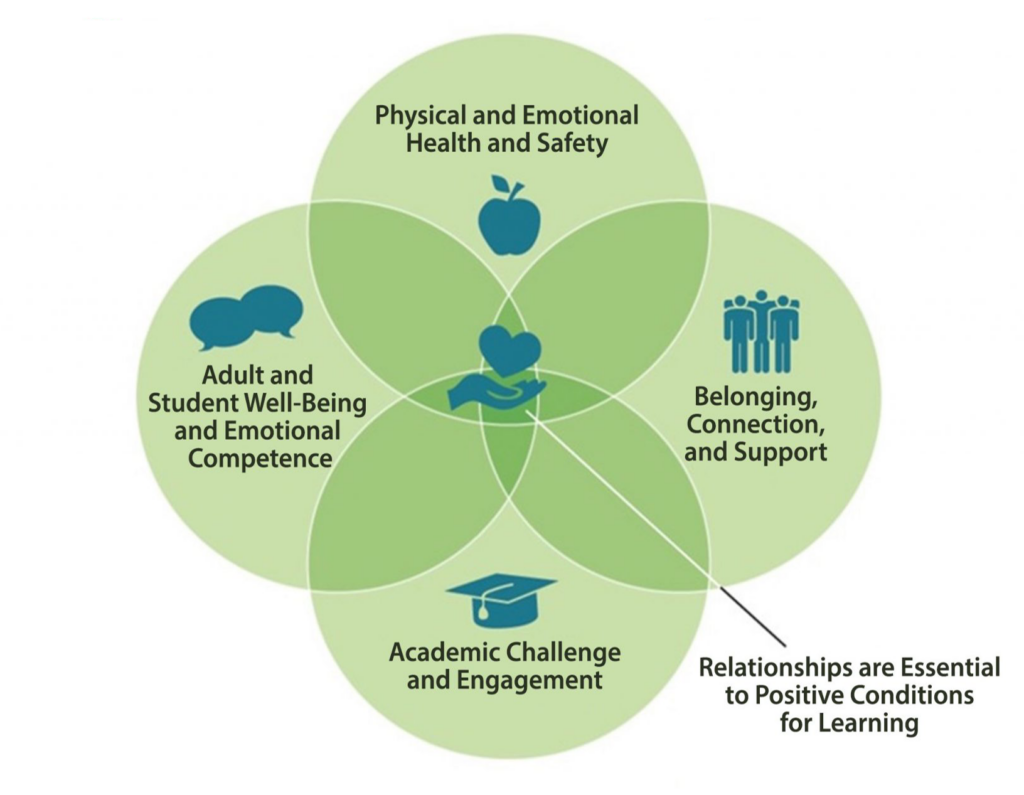
Focus on Positive Conditions for Learning
These stories demonstrate that when schools and districts intentionally focus on positive conditions for learning, African American students can flourish.
© Attendance Works, attendanceworks.org
It is also critical that school leaders address barriers to attendance and engage students and families as partners in shaping expectations for school experiences. This begins with building trusting relationships with students and families and eliciting from them what they need to engage and succeed in school. Examining data and having the courage to act when those data reveal inequities are important first steps in addressing challenges.
Implementing a Tiered System of Supports can help schools identify the right strategies. This begins with communicating the importance of regular attendance, offering a wide range of after-school activities, or providing all students with a “home base,” as O’Farrell Charter High School does.
It is also important to implement culturally appropriate universal Tier 1 supports, like offering warm and welcoming greetings when students enter school and displaying artifacts in hallways and classrooms that celebrate the diversity of ethnic and cultural groups in the school. When chronic absence rates are similar for all student groups, it is a sign that Tier 1 supports should be expanded or deepened. When chronic absence is high among African American students, it may indicate that those Tier 1 supports are not designed to meet their needs.
For students and families experiencing greater challenges, schools might implement Tier 2 strategies such as a walking school bus or gas cards. When Tiers 1 and 2 supports prove inadequate, schools may benefit from partnering with community-based organizations to provide additional support on a case-by-case basis.
Problems that seem intractable are problems we can solve. We must be intentional, courageous, and confident that our schools can serve and support our African American students in more ways that are holistic and responsive.
[1] Blazar, D. (2024). Why Black teachers matter (EdWorkingPaper: 21-501). Annenberg Institute at Brown University. https://doi.org/10.26300/jym0-wz02
[2] Johnson, J., Jr., Uline, C.L., & Munro, S. J., Jr. (2023). When Black students excel: How schools can engage and empower Black students. Routledge.
Newcomer Toolkit
The Newcomer Toolkit is designed to help U.S. educators, elementary and secondary teachers, principals, and other school staff who work directly with immigrant students—including asylees and refugees—and their families.
The Newcomer Toolkit has 5 chapters, and contains an overview, sample tools, and resources
In this guide:
Chapter 1 – Who Are Newcomers?
Chapter 2 – Welcoming Newcomers to a Safe, Inclusive and Thriving School Environment
Chapter 3 – Supporting Newcomers’ Social, Emotional, and Mental Health Needs
Chapter 4 – Providing High-Quality Instruction for Newcomers
Chapter 5 – Establishing Partnerships with Families
How School Facilities Impact Student Health and Performance: Advancing Equity With Green Infrastructure
This brief informs California’s LEA leaders about approaches to sustainably modernizing school facilities to advance educational and health equity for students and briefly explores associated funding strategies.
Colorado Department of Education Equity Toolkit
The Western Educational Equity Assistance Center (WEEAC) at WestEd partnered with the Colorado Department of Education to produce a toolkit to support school and district leaders in centering equity to improve student outcomes. The toolkit provides resources to help leaders create welcoming environments where all students and families feel a sense of belonging.
From Policy to Practice: Preventing and Addressing Bullying and Discriminatory Harassment
This webinar delves into the implementation of policies within educational environments. It provides valuable resources and practical insights from district leaders who have successfully defeated bullying along with shared evidence-based strategies to disrupt such behaviors.